Our planet has a total of 260 chalk streams of which 224 are in England. Chalk streams provide a unique environment that enables the growth of a wide range of plants and animals ( https://www.wildlifetrusts.org/habitats/freshwater/chalk-rivers ). English chalk streams are world-famous for their trout and salmon. Unfortunately, many of these streams are now deemed to be of poor quality due to sewage discharges and run-off from farms. It is important, therefore to monitor the quality of the water in these streams and to alert water companies and local authorities when the data obtained imply that there is a problem.
I head a team of volunteers who are monitoring the quality of the water in the River Pang which is a tributary of the River Thames in Berkshire. The river is 14 miles long and joins the Thames at Pangbourne.
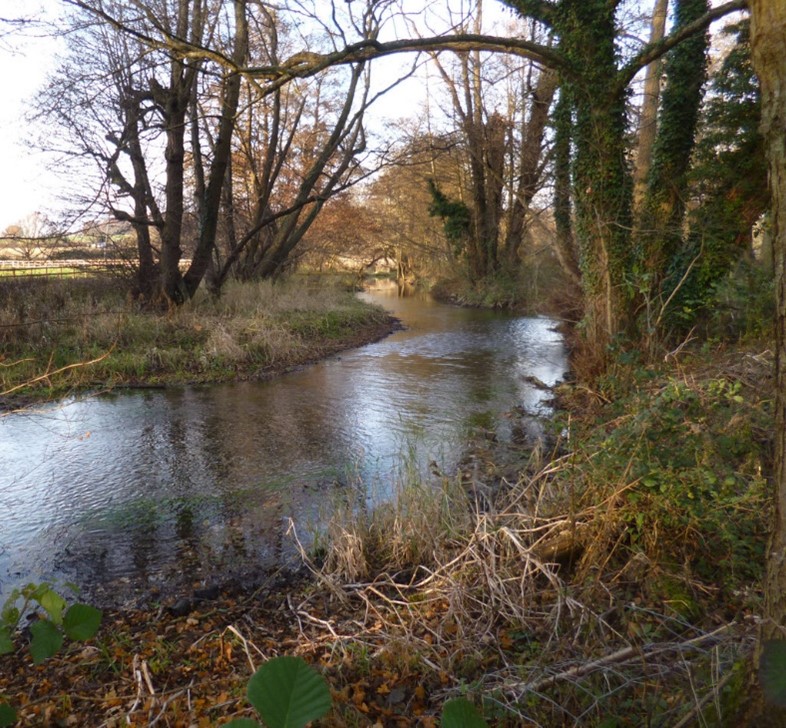
The River Pang near Bradfield Hall.
(Image courtesy of Des Blenkinsopp. This file is licensed under the Creative Commons Attribution-Share Alike 2.0 Generic license)
We are monitoring 5 sites along the length of the river as shown in the map below. The charity Action for the River Kennet ( https://riverkennet.org/ ) has kindly provided the funds needed to carry out this project.
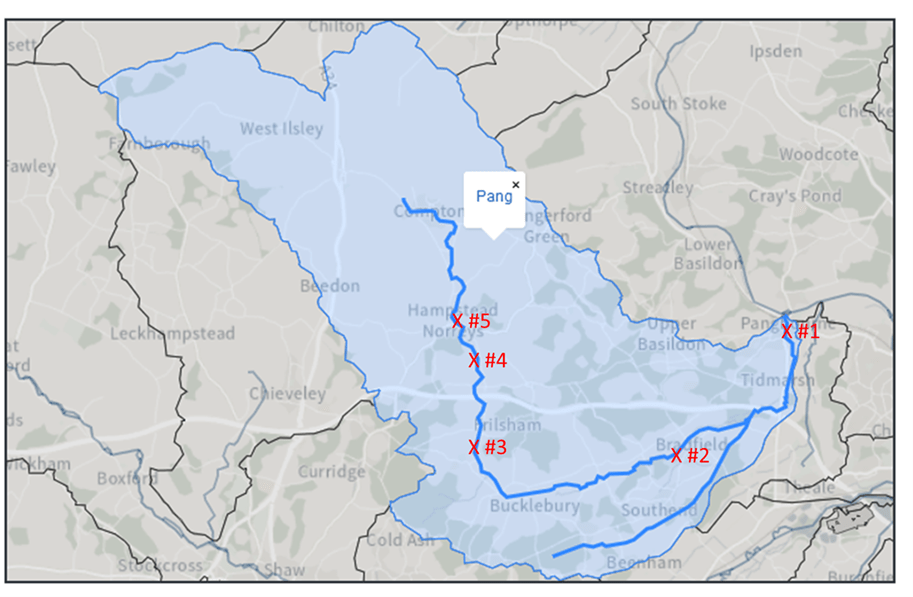
Map showing the sampling sites along the River Pang. Site #1 is very close to where the Pang joins the Thames. Site #5 is very close to the point where the Pang usually has water during the summer. Above this point it is a winterbourne.
The results obtained during the period October 2023 to April 2024 are summarised in the table below. The figures show the range of values found from a total of 19 samples per site.
| Site#1 | Site#2 | Site#3 | Site#4 | Site#5 | |
| Temperature (oC) | 6.1-14.3 | 6.3-14.8 | 7.0-14.8 | 7.6-16.5 | 7.2-15.5 |
| Total dissolved solids (ppm) | 216-327 | 224-323 | 223-342 | 268-352 | 258-361 |
| Conductivity (µS/cm) | 402-665 | 446-647 | 436-682 | 542-700 | 516-726 |
| Nitrate N (mg/L) | 0-10 | 0-20 | 0-20 | 0-20 | 0-20 |
| Phosphate P (mg/L) | 0.09-0.62 | 0-0.38 | 0-0.18 | 0.11-0.41 | 0.04-0.22 |
| Ammonia (mg/L) | 0-1.84 | 0-1.24 | 0-0.18 | 0-0.07 | 0-0.04 |
| Total viable count of bacteria (cfu/ml) | 500-1,000,000 | 500-100,000 | 100-100,000 | 100-1,000,000 | 100-2,000,000 |
| Coliforms (cfu/ml) | 10-5,000 | 10-5,000 | 10-10,000 | 0-10,000 | 10-10,000 |
| E. coli (cfu/ml) | 0-50 | 0-100 | 0-100 | 0-100 | 0-200 |
| Dissolved oxygen (mg/L) | 9.1-12.8 | 8.8-12.1 | 9.4-12.2 | 9.1-11.5 | 8.9-11.2 |
| pH | 7.0-7.9 | 7.3-7.8 | 7.4-7.8 | 7.3-7.8 | 7.2-8.1 |
On the basis of these findings we identified two main areas of concern. Firstly, high concentrations of phosphate were found on many occasions. Government guidance recommends that, in order to be classified as being of a “high” standard, rivers like the Pang should not exceed annual mean phosphate concentrations of 0.04mg per litre (Updated recommendations on phosphorus standards for rivers (2015-2021). UK Technical Advisory Group on the Water Framework Directive. Final Report August 2013). Unfortunately, we found that 91% of the samples analysed had phosphate (as Phosphorus) concentrations greater than 0.04 mg/L. Phosphate is an important plant nutrient which, in high concentrations, results in rapid growth of algae resulting in “algal blooms”. These dense algal communities hinder the growth of other aquatic plants, increase the pH, produce toxins and, when they die, their microbial decomposition lowers the oxygen concentration resulting in the death of fish and a range of aquatic organisms.
Secondly, we found high concentrations of E. coli in many samples. According to the Bathing Water Regulations ( https://www.legislation.gov.uk/uksi/2013/1675/contents/made ) a river is classified as “excellent” if it has fewer than 5 cfu/ml of E. coli. In 28% of the samples taken, the concentration of E. coli was greater than 5 colony-forming units (cfu)/ml. In 18% of the samples it was 10 times higher than this cut-off concentration. The presence of E. coli in a water sample is dangerous because this organism can cause disease. It also shows that the river has been contaminated with faeces from humans or other animals and so may contain other disease-causing microbes.
 Mike's Books